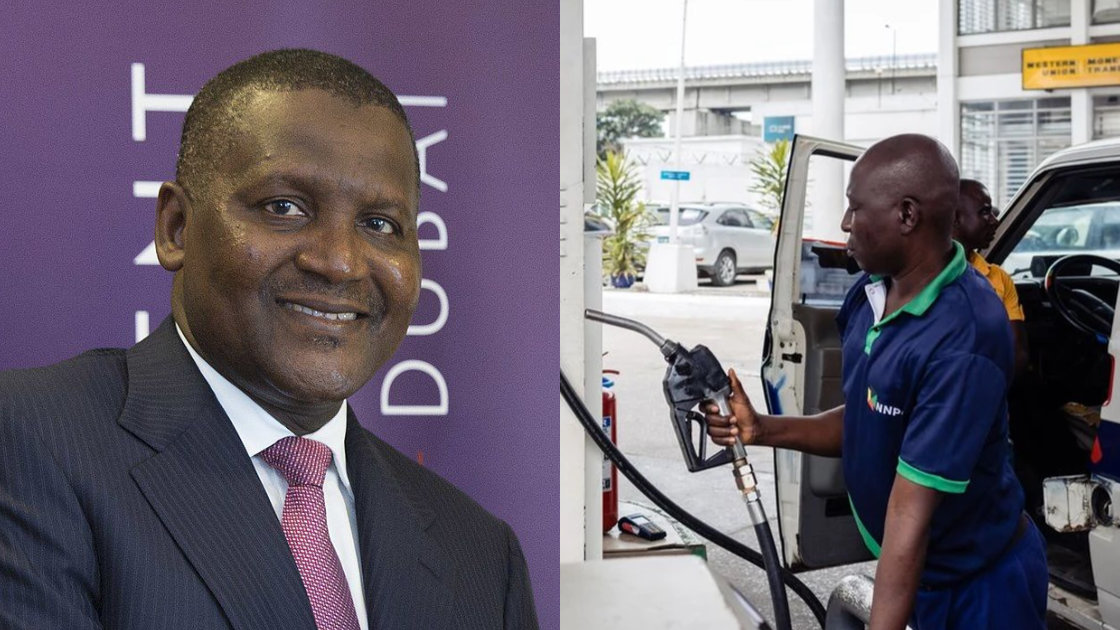
Aliko Dangote (L)
Aliko Dangote, Africa’s richest person and owner of the continent’s biggest refinery, risks popular backlash: In response to the jump in crude prices since the beginning of the war on Iran, the Dangote Refinery has increased pump prices at least five times, from about NGN 774 (~USD 0.56) to NGN 1,245 (~USD 0.90) per litre, an increase of 61 percent in less than a month. The price of diesel rose by the same percentage.
Transport costs have jumped by more than 100 percent in many places, and this will feed through to the cost of food as many food items are produced in rural areas and need to be transported to the urban centres. Initial price increases are already being applied to some widely consumed items.
The price of Brent crude, which Nigeria’s crude is benchmarked against, has jumped by an average of 57 percent since the US-Israeli war on Iran started, from an average pre-war level of about USD 70 per barrel to around USD 110 per barrel. With no mechanism to absorb the additional cost, Dangote is obliged to pass it on to consumers.
Since the 650,000 bpd Dangote Refinery became operational, it has started dictating domestic prices of both petrol and diesel. Data from the Nigerian Midstream and Downstream Petroleum Regulatory Authority (NMDPRA) show that the Dangote Refinery accounted for nearly 70 percent (or 36.6 million litres/day) of the 56.9 million litres/day consumed domestically in February 2026. However, Dangote claims he has the capacity to supply as much as 75 million litres/day since the plant is currently operating at full capacity.
The wider population is conveniently blaming not the government, but Dangote for the sharp increases in petrol prices. He has always had a mixed reputation: often admired as one of Nigeria’s greatest businessmen, there is also the perception that his success was helped by the many favours he has received from the government, and that he does not have the interest of ordinary people at heart.
Dangote’s dominance of the cement market and the high cost of cement, an essential building material, has also been noted by the public – who worry that he will repeat this dynamic in the fuel sector, where his refinery was initially welcomed with much sympathy. Relatively few understand the linkage between the US-Israeli war on Iran and pump prices, and so Dangote is blamed.
Dangote will not be able to raise prices infinitely. Protests will likely be held once petrol pump prices rise to NGN 1,500 (~USD 1.08) per litre, and they are already between NGN 1,300 (~USD 0.94) and NGN 1,400 (~USD 1.01) in most places. In a pre-election year, the government cannot afford a cost-of-living crisis, even if the opposition is in disarray and unlikely to pose a significant threat. It will be forced to act, either by subsidizing the crude sold to Dangote so that he can absorb the rise in the international crude prices, or by directly subsidizing refined products. However, the government will also need to avoid the risk of the 2027 election being discredited both locally and by the international community. The credibility of Tinubu’s win in 2023 had been questioned widely, and he will not want a repeat of this in his second term.
For Dangote, pump price increases mar his carefully built image as a great businessman. If that public sympathy is eroded, he may find it a little more difficult to win favours if the the government begins to perceive that granting such favours fuels public resentment.
Dangote loses incentive to offer cheap fuel locally
The US-Israeli war on Iran and the impact of the closure of the Strait of Hormuz have cleared any doubts about the significance of the Dangote Refinery. While other African countries are concerned about dwindling stocks of refined products and urge residents to start rationing its usage, Nigerians have no such worries. Petrol prices may have risen, but there are no concerns about the availability of products.
With the refinery now operating at a full capacity of 650,000 bpd – with the potential to reach 700,000 bpd by the end of 2026 – it is able not only to meet national demand, but also to export. Dangote claims to have received requests from South Africa, Kenya and Ghana and other, non-African countries.
Dangote has already exported some output, and the refinery will have continued demand from African and European countries even after the war, as countries seek to reduce their dependence on supplies from the Middle East. Dangote is well positioned to benefit from this diversification. The refinery is in one of the few countries that also produces crude oil – giving it easy access to crude, especially if it can convince the government to increase its crude allocations from the state-owned Nigerian National Petroleum Company Limited (NNPCL).
Presently, Dangote claims to be able to process 13 cargoes of crude, but to only be receiving only five cargoes from the NNPCL – leaving him forced to import the remainder. Given the shifting geopolitical context, the government is expected to push the NNPCL and other oil majors to allocate more crude to Dangote to refine, both for domestic consumption and exports.
Dangote’s refinery also plans to expand its output to 1.4 million bpd by mirroring the existing plant. This will render supplies more reliable, something the refinery has struggled with since starting operations in early 2024. The plant can refine crude at the highest specification required for Europe, which means that it is ready for export markets. Dangote’s struggle for market share in the past two years appears to be over: It will become the primary source of refined products on the continent and a buffer for Europe in the next few years.
On the downside, this may also be the end of cheap fuel in the local market: Dangote may no longer need to offer significant discounts to win market share, and the refinery may choose to sell to the buyers with the best profit margins. Supplies to the local market will have to be benchmarked against international prices.
This excerpt is taken from Nigeria Focus, our monthly intelligence report on Nigeria. Click here to receive a free sample copy.The March 2026 issue of Nigeria Focus also includes the following:
Implications
Spotlight
- The outlook for security in the north is bleak and could hurt Tinubu
Politics
- Is Tinubu making El-Rufai more popular?
- WIll Obi run with Kwankwaso?
- APC receives its 31st governor
Economy
- Naira withstands test of the US-Israeli war on Iran
- Electoral pressure may still affect the naira
Energy
- Dangote faces backlash over fuel price increases
- Dangote loses incentive to offer cheap fuel locally
- OPL 245 resolution to boost Nigeria’s oil production
- War on Iran likely to boost interest in Nigeria’s oil block sales
- Tinubu’s new super task force will deepen oil and gas reforms
- Oil production decline may offset windfall from price increases
Security
- Tinubu gets backing of major powers over security issues, but this may backfire
Numbers